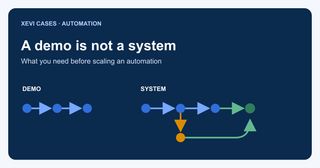
The meeting where everything works
Imagine an internal demonstration.
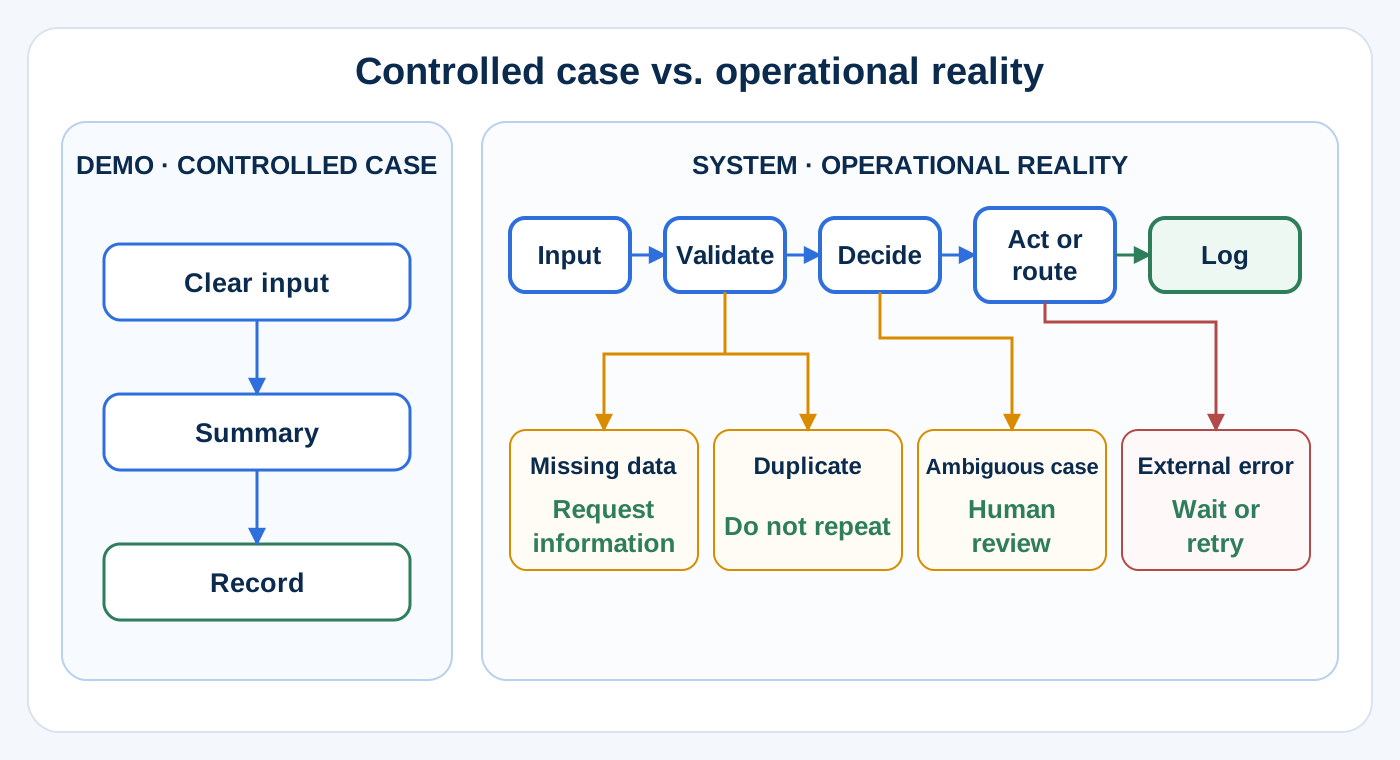
A well-written sales enquiry comes in. The person explains what the company does, which process they would like to improve and when they need an initial response. The system reads the message, prepares a summary, classifies it as a potential opportunity, creates the corresponding record and alerts the team with the necessary context.
It all happens in less than a minute.
The classification is correct. The record is created properly. The alert reaches the right person. The demo works, and its value is easy to see.
The problem is not the demo. The problem is confusing what it has just demonstrated.
During that test, the input was complete. There were no duplicates. The destination tool responded. The credentials were valid. The request fitted a clear category, and nobody had changed the criteria since the flow was prepared.
Different cases may arrive the next day.
A message that only says “call me”. A repeated submission because someone clicked the button twice. An enquiry that mixes a sales opportunity with a support issue. An attachment the system cannot read. An external tool that stops responding for a few minutes. Or a request that appears urgent but does not contain enough information to decide.
These cases are not anomalies in the process. They are the process when it meets day-to-day reality.
A demo can show that an idea is possible. A real system must know what to do when reality stops following the script.
If the process still lacks criteria, minimum data or clear ownership, first consider when not to automate yet. Here we start at a later point: a demo or pilot already exists, there is potential value, and the question is what is still missing before it can enter operation or scale.
A demo tests a possibility, not an operation
A demonstration serves an important purpose. It can validate that two tools connect, that AI can prepare a first reading or that an action can be executed without building the whole system.
It is a quick way to learn.
But a real operation asks different questions. It does not only ask whether the flow advances when everything goes well. It asks whether the flow can stop when information is missing, prevent duplicate actions, recover from errors, record what happened and alert someone when it needs help.
| A demo can demonstrate | It does not yet demonstrate |
|---|---|
| That two tools can connect | That the flow will withstand change, errors and higher volume |
| That the clear case works | That it will stop when data is missing, duplicated or ambiguous |
| That the output is convincing | That the criteria will be consistent, reviewable and right for the business |
| That an action can be executed | That it will not be duplicated and can be corrected or recovered |
| That there is potential value | That the team will adopt it and someone will own it |
This does not diminish the value of the demo. It simply puts it in the right place.
The demo answers “can we do it?”. Before scaling, we still need to answer “how will it work when things do not go as expected?”.
Five questions before putting it into day-to-day operation
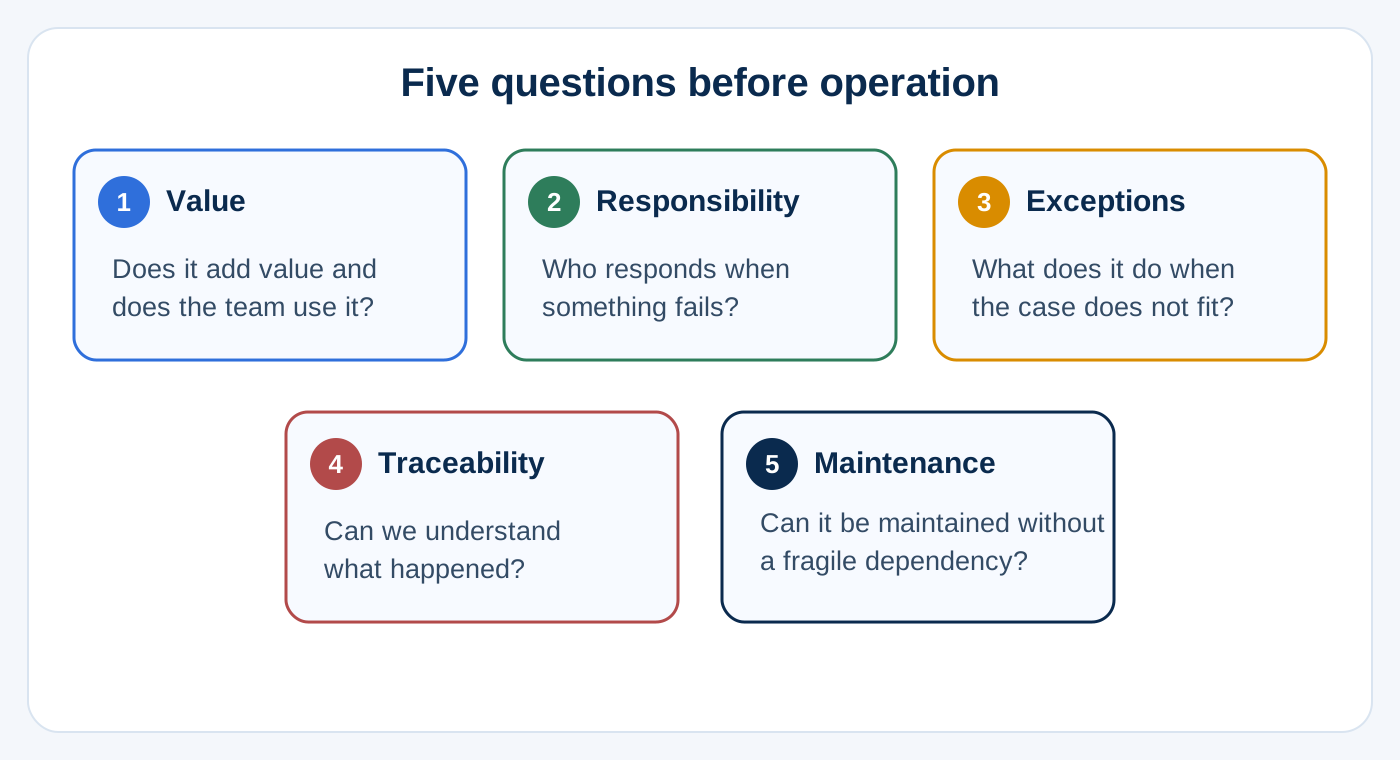
There is no exact boundary that turns a test into a system. But five questions can help reveal whether the foundation is solid enough.
They are not merely technical questions. They concern use, ownership, exceptions, control and maintenance. This is where many automations that impress during a presentation begin to reveal their weaknesses.
1. Does it create value, and does the team use it?
The first question is not whether the flow runs. It is whether it changes something useful in the work.
Perhaps it reduces the time to first response. Perhaps it removes data copying. Perhaps it helps identify missing information or leaves every case in a clearer state. The result may also be correct while the team continues working through email, chat or a parallel spreadsheet because the new system does not fit the real routine.
Scaling an automation that nobody adopts only multiplies a layer the team will work around.
There is no need to demand ten indicators or a huge dashboard. But there should be two or three pieces of evidence: the friction we intended to reduce has fallen, the result is used, and the people working with it trust the record enough.
This is covered in more detail in how to tell whether an automation is really working. Here it is the entry condition: before reinforcing the operation, confirm that there is an operation worth reinforcing.
2. Who is responsible when something fails?
A flow can run without direct supervision. A process cannot be left without an owner.
Someone must know it exists, understand the problem it solves and have the authority to decide what happens when an exception appears. That person does not necessarily have to repair an integration, but they must be able to answer basic questions:
- Who receives an alert if an input cannot be processed?
- Who decides whether to retry, correct a data point or contact the person?
- Who can stop the flow if it starts behaving incorrectly?
- Who reviews whether the criteria still make sense over time?
Technical maintenance can sit with an internal or external team. But the business criteria need an owner within the organisation.
Without this role, the system can keep working technically while the process changes around it. It may assign statuses that are no longer used, alert someone whose role has changed or apply a priority the team no longer considers correct.
An automation without an owner does not stand still. It gradually drifts away from the real way of working.
3. What does it do with poor data, duplicates and exceptions?
Reliability does not mean never failing. It means failing without losing control.
If an email address is missing, the system should not invent one or create a record that looks complete. If an entry is duplicated, it should not generate two follow-ups. If a classification is ambiguous, it should not choose an option simply because it needs to continue. If the destination tool does not respond, it should not mark the case as resolved.
At these points, a system can ask for the missing data, leave the case pending, send it for review, retry later, alert someone that the action was not completed or stop before causing an external effect.
Stopping is also a response.
In fact, it is often the response that separates controlled automation from a flow that only knows how to move forward. When every error forces someone to investigate what happened, reconstruct the case and correct records, the system is not yet taking on the operation. It is only executing the easy part.
The most dangerous case is not always a visible error. It may be an apparently successful run that performed the wrong action: duplicated a contact, updated the wrong record or sent a response without enough context.
An error that is visible and recoverable is usually less costly than a false success that nobody detects.
4. Can we see, understand and correct what happened?
When someone makes a decision in a process, we can usually ask what they saw and why they acted that way. With automation, that trace must be designed.
It is not enough for the system to store technical information that only its builder understands. The team should at least be able to see the input it received, the classification or proposal it generated, the action it attempted, whether it completed, the error that appeared and whether a person changed the result.
This is especially important when AI is involved. If a request is rejected, prioritised or routed elsewhere, it should be possible to review the information available and the criteria that had been defined. Not because the system must justify every word, but because an operational decision must be reviewable.
Traceability also speeds up corrections. If an action was repeated, we need to see whether the entry arrived twice or the system retried incorrectly. If a record was not created, we need to know whether data was missing or the external tool was unavailable.
Without this visibility, every incident starts from zero. And when every error requires a bespoke investigation, scaling also scales the time spent understanding what happened.
5. Can it be maintained without becoming a fragile dependency?
A system is not finished on the day it is published.
Forms, CRM statuses, responsible people, permissions, information sources and sales criteria all change. Volume can change too: a flow designed for a few entries may start receiving many more when it is opened to another channel or team.
Before scaling, I would therefore look at four very specific things.
The first is cost. Not only the initial build cost, but the cost of each execution, the connected tools and the human review that remains necessary. An automation can create value and still need consumption limits or alerts so that growth does not turn a small bill into a surprise.
The second is permissions. Each connection should have only the access it needs. If a flow only creates tasks, it does not need permission to delete records. If it works with sensitive information, define who can access it and what is logged.
The third is how changes are made. Before changing criteria or an action, test it with known cases, see what it would do and retain a way back to the previous version if the result is not as expected. Simulating before execution is particularly useful when a flow sends, publishes, modifies or deletes information.
The fourth is minimum documentation. There is no need for an enormous manual, but it should be clear what triggers the flow, which data it uses, what actions it can perform, who owns it, how to stop it and what to check when an alert appears.
If only one person knows how the entire system works, you do not yet have an operational capability. You have a dependency.
The same case, from demo to system
Between the demo and the operational version lies a step that should not be skipped: the supervised pilot. The same flow can begin working with real inputs without executing every action on its own. It summarises the request, proposes a classification, identifies missing data and prepares the record; a person reviews the proposal, corrects the criteria when necessary and approves the next step.
This phase reveals which exceptions repeat, where classification is too ambiguous and which controls are missing before the system is given more autonomy.
If you are still comparing opportunities and have not decided which case should become a test, first read How to choose your first AI pilot without losing months. This helps avoid confusing a successful demo with a well-scoped first pilot.
If the case begins with a web submission, remember that a form is not a process: before scaling it, define what happens to incomplete data, duplicates and statuses, and who is responsible for each case.
In this pilot, the message “call me” would not proceed as though it were a complete opportunity. The flow would mark it as an entry with insufficient context, prepare the information that needs to be requested and leave the next step pending for human review. If the same entry arrived twice, it would also show the potential duplicate before creating a second record.
The pilot does not try to prove that the system can already act alone. It uses real cases to observe where the criteria still need a human decision and which controls must be added before granting more autonomy.
Return to the sales enquiry at the beginning. In the demo, the route is simple: a clear message arrives, the AI summarises it, classifies it as an opportunity, creates a record and alerts the team. This sequence may be enough to validate the idea. But putting it into daily operation broadens the question: what should happen to every input that is not so clear?
A first operational version could begin by validating the minimum data. If there is no way to contact the person or the message lacks enough context, the case does not proceed as though it were complete. It is marked as awaiting information or sent for review.
It can then check whether a similar entry already exists. Perhaps the person submitted the form twice or also wrote by email. Instead of creating two cases, the system can link them or flag a potential duplicate.
Only then does summarising and classifying make sense. Clear cases can continue. Those that mix needs, contain contradictory information or fall outside the expected categories can reach a person together with the reason for escalation.
The action still has to be executed. If the CRM is available, the record is created or updated. If it is not, the request remains in a pending queue, is retried and triggers an alert if the problem continues. The system cannot claim it has finished when the important part was not completed.
The route is no longer just a line:
- Input
- Validate minimum dataIf data is missing, request it or route the case.
- Detect duplicatesLink them or warn before creating a new record.
- Summarise and propose a classification
- Decide
- act
- request information
- review
- stop
- Create or update the recordOr leave it pending for retry.
- Alert the responsible personWith the necessary context.
- Record the resultLeave a trace of the action, exception and review.
This version looks less spectacular because a significant part of the flow is dedicated to avoiding the wrong action. But it is much more useful.
It also generates information the demo could not provide. It shows how many entries arrive incomplete, which duplicates are common, which cases are not separated well by the classification and which incidents depend on an external tool.
This turns the system into a source of learning about the process.
The first real version does not have to solve everything. It can automate only the clear cases and prepare the others better. The criterion is not how much apparent autonomy it has, but whether every result ends in a comprehensible state with a next step.
Four stages and what must be true before advancing
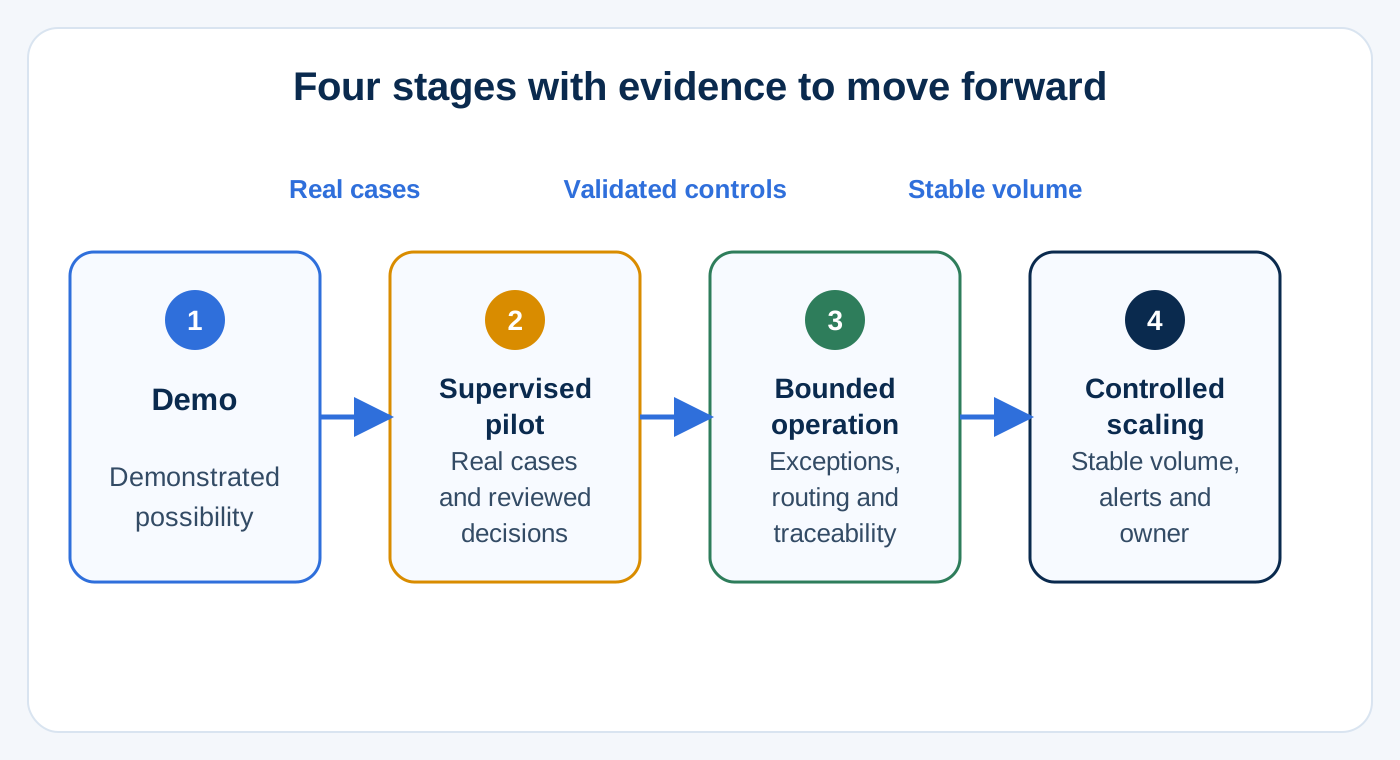
Moving from a demo to a system is not a single leap. It is more useful to see four stages, each requiring different evidence.
| Stage | What happens | What must be true before advancing |
|---|---|---|
| Demo | The controlled case works and the connection is possible. | The result addresses a specific friction and is worth testing with real data. |
| Supervised pilot | It works with real cases, but a person reviews relevant actions. | Usage patterns, repeated exceptions, useful criteria and measurable improvement can be seen. |
| Bounded operation | It resolves clear cases, routes uncertain ones, recovers errors and leaves a trace. | There is an owner, alerts, stable criteria and a clear way to maintain it. |
| Controlled scale | Volume, users or scope increase without losing visibility or control. | Costs are known, changes are tested, permissions are bounded and reviews are periodic. |
None of these stages is a badge of prestige. A supervised pilot may be exactly what a process with external impact or evolving criteria needs.
The problem is not remaining in one stage for a while. The problem is acting as though you have reached the next one without building the conditions that support it.
Scale one dimension at a time
When a pilot works, it is tempting to expand it in several directions at once: more volume, more channels, more teams, more case types and more autonomy.
That makes it difficult to know what caused an improvement or a problem.
You can scale one dimension. For example, keep the same type of case and increase its volume. Or keep the volume and open the system to a second team. Or retain human approval while adding a new source. You can also automate an internal action before allowing an external response.
This makes the change easier to observe.
If the system starts failing after another channel is added, you know where to look. If costs rise with volume, you can adjust them before broadening the scope. If a second team interprets categories differently, you can revise the criteria before granting more autonomy.
Scaling gradually is not a lack of ambition. It is a way to preserve the ability to learn.
One of the common mistakes in process automation is turning a successful first test into an oversized solution before understanding the exceptions. The best defence is to change one thing at a time and retain enough traceability to see what happens.
A matrix for deciding the next step
Not every successful pilot calls for the same decision.
| Current situation | Recommended next step |
|---|---|
| The result does not reduce clear friction, or the team does not use it. | Stop or reframe the case before adding more automation. |
| There is value, but exceptions and criteria still change frequently. | Continue with a supervised pilot and record the reasons for review. |
| Clear cases are well defined, but the action has an external impact. | Operate with human approval before sending, modifying or publishing. |
| The flow handles errors, avoids duplicates, routes uncertainty and leaves a trace. | Automate clear cases with limits and alerts. |
| There is sustained value, an owner, known costs and defined maintenance. | Gradually scale volume, users or scope. |
This matrix is not a certificate. It supports a more specific conversation than “we liked the demo”.
The right decision may be to advance, keep the pilot running a little longer, reduce its scope or stop. What matters is that the next stage responds to what you have learned, not only to the desire to deploy.
Good automation knows what to do when something goes wrong
A demo is necessary because it allows an idea to be tested without building everything. But its success is modest: it shows that the prepared case can work.
The system begins afterwards.
It begins when the team uses the result, someone takes responsibility, exceptions have an exit, actions leave a trace and errors can be recovered. It also begins when costs, permissions and changes no longer depend on one person’s memory.
Before scaling, I would return to the five questions: does it create value and does the team use it? Who owns it? What does it do with poor data and unexpected cases? Can we understand and correct what happened? Can it be maintained without becoming a fragile dependency?
Good automation is not automation that never fails. It knows how to stop, ask for help, leave a record and return to a controlled state when something does not go as planned.
The demo works. Now we need to know whether it can handle day-to-day reality.
If you have a pilot or automation that already creates value, we can start with a short diagnosis to see whether the constraint lies in the process, data, exceptions, ownership or controls. From there, we can decide whether to adjust the pilot, prepare a bounded implementation or avoid scaling for now. See how we work, explore the available solutions or go directly to contact.