Time saved is only the starting point
When a company considers automating a process, one of the first questions is usually a perfectly reasonable one: how many hours will we save?
It is a good question. But on its own, it can lead to an answer that is too simplistic.
A process does not only cost the time someone spends carrying it out. It may also create errors, rework, follow-ups, interruptions, waiting time, duplicate records and a constant reliance on somebody remembering what needs to happen next.
Think about a task that takes ten minutes every day. On paper, that is just over three hours a month. It may not look like much.
But those ten minutes may never come in one uninterrupted block. Someone has to remember the task exists, check whether something new has arrived, stop what they are doing, see whether information is missing, chase a response and return to it later.
The real cost of the process is higher than the minutes shown on a stopwatch.
So when I assess an automation opportunity, I would start with time saved, but I would not stop there.
The useful question is not only “How much time will this save?”
It is: “What cost and friction will it remove, and what will that allow us to do better afterwards?”
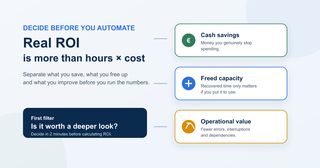
First filter: is this process worth analysing? Decide in 2 minutes
Before calculating any ROI, I would run a quick filter. It is not there to decide whether to invest, and it does not replace a proper process assessment. Its purpose is simply to decide whether this process deserves a deeper look.
- Does it happen often enough?A daily or weekly task usually has more potential than an occasional exception. It does not need to take hours every time: frequency can turn small amounts of friction into a recurring problem.
- Does it consume time, create errors or cause real friction?Look beyond hours. Are there corrections, follow-ups, interruptions, waiting, duplicate records or things that someone constantly has to keep in mind?
- Is part of it repeatable enough?Not every case needs to be identical. But there should be at least a reasonably stable set of data, steps or decision rules.
- What would you do with the capacity you free up?Handle more volume? Reduce overtime? Avoid outsourcing? Delay a planned hire? Spend more time with customers or on higher-value work?
- What happens if you do nothing?Will the problem stay the same, or grow with volume? Could it become a bottleneck, create more errors or force you to expand the team?
If it passes this first filter, then it is time to put numbers around the process. If you are still comparing possible use cases, this guide on how to choose your first AI pilot without losing months can help narrow the starting point. If you need to review process readiness before running the numbers, use the checklist before automating a process.
First, calculate what the process costs today
Before talking about AI, integrations or tools, understand what the current process actually costs.
You do not need a major finance exercise. In many cases, observing the process for one or two weeks and estimating four cost areas is enough.
Execution time
This is the most visible part.
If someone spends 30 hours a month copying data, classifying incoming requests, preparing documents or updating records, that time has a cost.
A useful first approximation is: monthly hours × effective internal hourly cost.
Do not confuse that figure with the employee’s take-home pay. If you are using the calculation to make a business decision, use a reasonable internal cost that reflects what that hour actually costs the organisation.
Errors and rework
Then there is the work that has to be done twice.
A mistyped value. A duplicate record. An incomplete order. A document that needs correcting. The same rule interpreted differently by two people.
This time often disappears when people estimate a process from memory.
So I would ask:
- how many cases need correcting;
- how long those corrections take;
- whether any errors create an external cost, a delay or a lost opportunity.
Coordination and follow-up
Another part of the cost is spread across several people.
Someone sends an email. Someone else asks whether it has been done. Another person checks the status. Someone remembers that a piece of information is missing. A week later, somebody follows up again.
None of these actions is particularly long, but together they can turn a small process into a constant source of interruption.
External costs
Finally, there may be tools, services or outsourced tasks directly linked to the process.
If automation removes any of them, that saving is straightforward to include.
With these four areas, you already have a much more realistic picture:
current cost = execution + corrections + coordination + external costs.
These categories should not overlap. If execution time already includes follow-ups or corrections, do not add them again in a separate block. The aim is to understand the real cost, not inflate it.
Calculate the real cost of automation too
Another common mistake is to compare the full cost of the manual process with only the initial build cost of the automation.
The comparison needs to be symmetrical.
Automation may have an upfront cost, but it can also have recurring costs and human work that does not disappear.
At a minimum, I would separate:
- design and implementation;
- integrations with existing tools;
- initial data preparation or clean-up;
- licences and service usage;
- maintenance;
- human supervision or review;
- internal team time during implementation.
This does not mean every project needs a large budget for every item. It means you should not pretend that, once built, the system will run for free forever.
Some automations are simple and need almost no maintenance. Others depend on several tools, changing rules or frequent human review.
That recurring cost belongs in the calculation.

Separate cash savings, freed capacity and operational value
A useful way to avoid inflated ROI calculations is to separate three types of return that are often mixed together.
1. Cash savings
This is the strictest category: money the company genuinely stops spending. This is the most conservative basis for measuring financial return.
2. Freed capacity
This is internal time the process no longer consumes, even though payroll does not automatically go down. Those hours only become real return if they are used better.
3. Operational and strategic value
Some benefits may matter a great deal even though they are difficult to monetise precisely: fewer interruptions, follow-ups, errors and dependencies, and greater capacity to handle volume.
That is why freed hours × internal hourly cost is an estimate of potential value, not necessarily a cash saving.
It is not always easy to convert all of this into euros. And you do not need to force it.
Saving ten hours does not automatically create ten hours’ worth of value. The value appears when those hours, or that operational improvement, have a concrete and observable use.
Run the numbers: cash return, economic value, payback and ROI
Once these categories are separate, decide first which return you are actually calculating.
monthly cash savings − monthly recurring automation cost
cash savings + defensible value of freed capacity − recurring cost
If that number is positive and reasonably stable, you can calculate a simple cash payback:
upfront investment ÷ monthly cash return.
The assumption needs to be explicit: if the freed hours do not have a clear productive use, do not count their full value as return.
For example, if the upfront investment is €3,000 and it creates €750 per month of net economic value on a reasonably stable basis, the simple economic payback period is 4 months.
You can also calculate ROI over a defined period. First define:
total accumulated cost = upfront investment + recurring costs over the period.
Then, for a strict cash view:
cash ROI = (accumulated cash savings − total accumulated cost) ÷ total accumulated cost × 100.
If you want to include freed capacity, you can calculate an estimated economic ROI, but only using a monetised value you can defend and with the assumptions stated clearly.
These formulas are approximations for comparing decisions, not a complete financial valuation. They do not account for factors such as discounted cash flows, tax or future variability.
A percentage without context can look impressive. Knowing how much is cash, how much is capacity and what assumptions sit behind the figure is far more useful for making a decision.
The harder value to price: less friction and less mental overhead
Some processes do not consume many hours, yet everyone would happily stop doing them.
Not because they are long, but because they are draining.
They force people to remember things. They interrupt work that requires concentration. They trigger small checks throughout the day. They depend on the person who knows “how this is done”. If that person is away, the process stops or everyone starts asking questions.
That cognitive load is real.
It is the mental overhead of having a task permanently sitting in the back of somebody’s mind.
Automating it may be worth far more than the raw minutes removed.
But I would avoid assigning an arbitrary monetary value to it.
Instead of claiming that “reducing stress is worth €500 a month”, I would ask observable questions:
- how many times a day does this process interrupt another task;
- how many people need to ask for or check its status;
- how many cases rely on somebody remembering a follow-up;
- what happens when the responsible person is away;
- how many steps exist only because nobody fully trusts that the process has been completed correctly.
These questions do not automatically turn friction into money, but they help distinguish a genuinely small process from one that takes up too much mental space across the organisation.
The best automation opportunities are not always the processes that consume the most hours. Sometimes they are the ones that create the most friction.
A complete example with numbers
Imagine an SME that receives requests by email and then enters them manually into its internal system.
Reading the message, identifying the request type, copying data, checking information, creating the record and notifying the right person takes the team around 40 hours a month.
Assume an effective internal cost of €30 per hour.
That is €1,200 per month in execution time.
On top of that, there are roughly five hours a month of corrections, duplicates and follow-up caused by incomplete information or transcription errors.
That adds €150.
The company also pays €100 a month for an auxiliary tool that would no longer be needed with the new solution.
The current attributable economic cost is therefore around €1,450 per month. But not all of that is cash that can be saved: part of it is employee time that will remain on payroll.
Now assume the automation can handle 70% of the clear execution work, cut correction time by 80% and remove that auxiliary tool.
The result looks like this:
- €840 of estimated value from freed execution capacity;
- €120 of estimated value from freed correction capacity;
- €100 of cash savings from the tool that is removed.
Total: €1,060 per month of potential economic value, of which only €100 represents direct cash savings in this example.
The solution has a recurring cost of €150 a month across services, maintenance and a small amount of human review.
That creates two very different readings:
If the upfront investment is €4,000, the project does not have a simple cash payback under these assumptions. The simple economic payback period would instead be:
€4,000 ÷ €910 ≈ 4.4 months.
That 4.4 should not be presented as “4.4 months to get the money back in the bank”. It is an estimate of when the economic value generated would offset the upfront investment, assuming the freed capacity is genuinely put to productive use.
If those hours help avoid overtime, outsourcing or a planned hire, some of that capacity may turn into actual cash savings and the financial case becomes stronger.
There is also a second layer we have not monetised: fewer interruptions, less reliance on remembering follow-ups, fewer duplicate records, more consistent information and greater capacity to handle volume.
Those benefits strengthen the decision, but you do not need to force them into a euro figure to justify the business case.
As a general rule: if the project already makes sense on cash savings alone, even better.
When an attractive ROI is still a bad decision
A spreadsheet can produce an attractive result and the project can still be a bad idea.
If the process changes every week, for example, maintaining the automation may cost far more than expected.
If there are many exceptions and you are only automating the ideal case, the 70% saving you assumed may not exist in practice.
If a wrong action has serious consequences, economic return does not automatically compensate for the risk.
And if the team does not actually use the system, any ROI based on full adoption is fictional.
Without repeating the full process-maturity assessment covered in when not to automate yet, there are a few checks that can invalidate an apparently attractive ROI.
Before trusting the calculation, I would review at least five questions:
- Is the process stable enough to automate?
- Do we have enough data to estimate volume and exceptions?
- Will the automation remove work, or simply move it somewhere else?
- Will recurring and maintenance costs still be acceptable if volume grows?
- Is the risk of a wrong action under control?
If one of the answers is unclear, I would not necessarily reject the project.
It may simply be too early to build the full version.
That is where a tightly scoped pilot makes sense: it allows you to validate volume, savings, exceptions and human review before committing to a larger investment.
A practical rule for deciding the next step
There is no universal payback period that works for every project.
A critical automation with high risk or many dependencies needs more evidence than a simple, reversible internal workflow.
But you can still use a practical decision framework.
Scroll horizontally to see all table columns.
| Situation | Interpretation | Recommended next step |
|---|---|---|
| Low cash savings, little freed capacity and little friction | Weak return | Do not prioritise |
| Cash savings are small, but friction is high and the process is stable | There may be real operational value | Run a short pilot |
| Clear cash savings or freed capacity with a defensible productive use | Good candidate | Design a scoped pilot or implementation |
| ROI looks high but relies on weak assumptions | Too much uncertainty | Measure before building |
| Return is good but operational risk is high | ROI alone is not enough | Add controls, human review and limits |
This table is not a substitute for analysing the process. It is there to avoid two extremes: automating because something “sounds good”, or rejecting an opportunity simply because it does not remove enough hours.
Do not optimise only for savings. Look for an improvement you can defend
A good automation is not necessarily the one that removes the most hours of work or produces the most impressive ROI percentage.
It is the one that solves a real source of friction at a proportionate cost and risk.
Sometimes the return will come from reducing real spend. Sometimes it will come from turning freed hours into useful capacity or reducing errors. In other processes, the main value will be no longer having to chase information, reducing interruptions or making sure knowledge no longer lives in one person’s head.
The important thing is not to mix all of these into one number.
Measure the cash savings you can defend. Value freed capacity only when it has a clear productive use. Identify operational value without inventing numbers. Then make the decision with those distinctions visible.
If you already have a pilot running and want to check whether it is improving the process, read how to tell if an automation is really working. If it works and you want to move it into operation, review what stands between a demo and a real system.
Does one of your processes pass this first filter?
Tell me what the process is, how often it happens and where it creates the most friction. An initial assessment can tell us whether there is enough potential to justify a deeper look. If not, it is better to know before you invest.